
Spiral Welded Steel Pipes
HS Code: 73053900
Introduction
Spiral Welded Steel Pipes, also known as MS H-SAW (Helical Submerged Arc Welded) or SSAW (Spiral Submerged Arc Welded), are manufactured using double-sided submerged arc welding from mild steel (MS). These pipes are formed from narrower sheets or hot rolled coils, significantly reducing production costs. Their ability to produce large diameter pipes makes them ideal for transporting oil, gas, water, and sewage, as well as for structural and industrial applications.
Key Benefits:
-
Cost-effective production for large diameter pipes.
-
High strength and durability for diverse applications.
-
Compliance with international standards for reliability and performance.
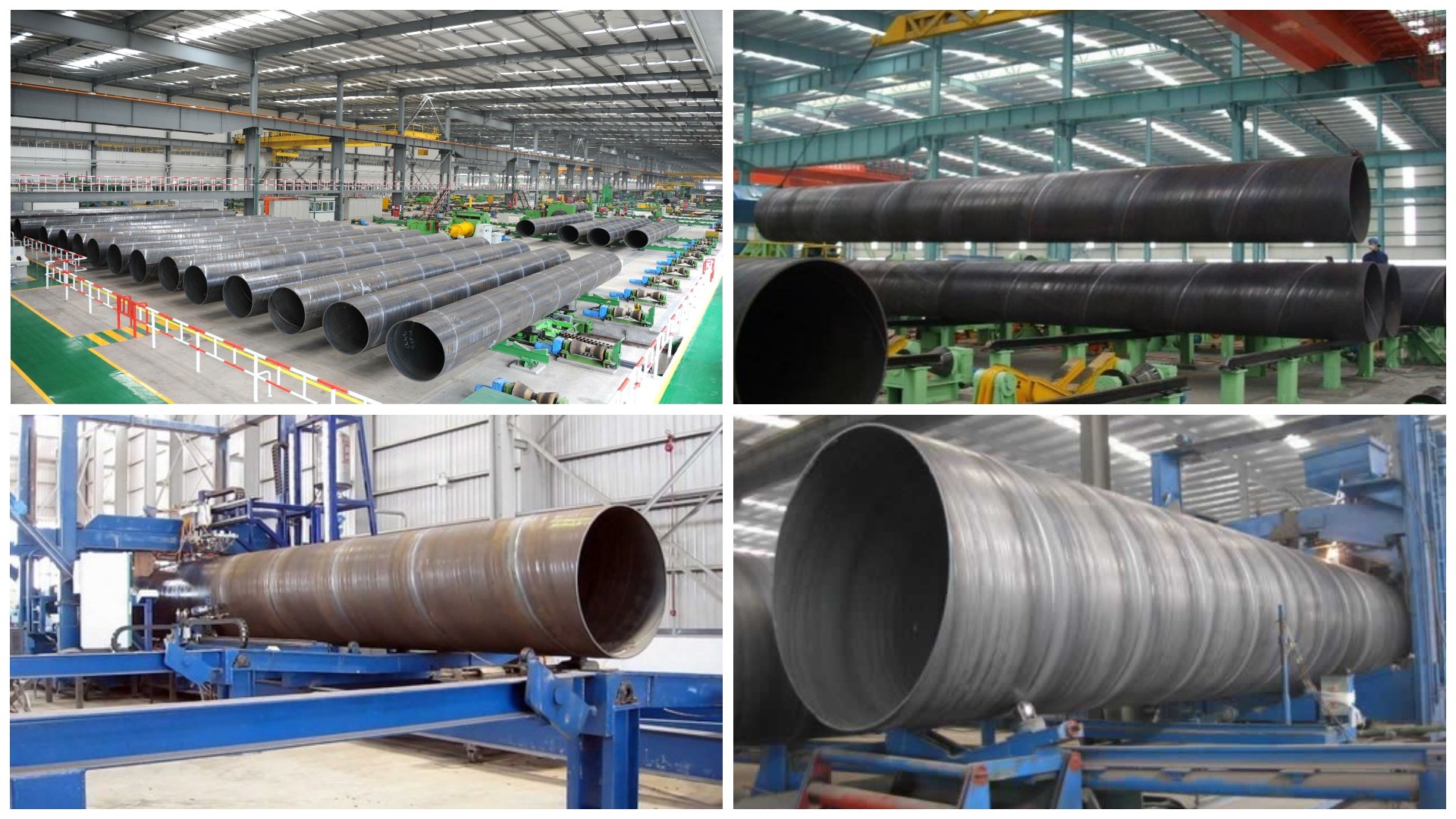
Metal Grades Comparison
The following grades are commonly used for spiral welded steel pipes. This standardized comparison helps buyers select the appropriate grade based on strength, application, and environmental requirements.
API 5L
-
Type: Carbon and alloy steel.
-
Standard: API 5L (ANSI/API specification).
-
Yield Strength: Varies by grade; A25 (172 MPa), A (207 MPa), B (241 MPa), X42 (290 MPa), X46 (317 MPa), X52 (359 MPa), X56 (386 MPa), X60 (414 MPa), X65 (448 MPa), X70 (483 MPa), X80 (552 MPa).
-
Equivalents: Comparable to ASTM A106, ASTM A53 for certain grades.
-
Wall Thickness: 6.2 mm (5.75 mm), 8.2 mm (7.75 mm), 10.2 mm (9.75 mm), 12.2 mm (11.75 mm), 25 mm, 36 mm, 40 mm.
-
Applications: Oil and gas pipelines, high-pressure fluid transport, and structural applications requiring high strength.
-
Key Features: Available in PSL1 (standard quality) and PSL2 (higher quality with stricter requirements). Offers excellent toughness and corrosion resistance for demanding environments.
-
Comparison: Highest strength range (up to 552 MPa), designed for critical applications like pipelines, with superior performance in high-pressure and corrosive conditions compared to Q235B, Q345B, Q355D, and S355J2H.
Q235B
-
Type: Carbon structural steel.
-
Standard: GB/T9711-2020.
-
Yield Strength: Approximately 235 MPa (may vary with thickness).
-
Equivalents: European S235JR (DIN EN), American ASTM A36.
-
Wall Thickness: 5.0 mm to 25 mm.
-
Applications: General structural applications, including buildings, bridges, and non-critical infrastructure.
-
Key Features: Cost-effective with good weldability and moderate strength, suitable for low-stress environments.
-
Comparison: Lower strength than API 5L, Q345B, Q355D, and S355J2H, making it less suitable for high-pressure or heavy-load applications but ideal for cost-sensitive projects.
Q345B
-
Type: Low-alloy steel.
-
Standard: GB/T700, GB/T1591.
-
Yield Strength: Approximately 345 MPa.
-
Equivalents: European S355JR or S355J2 (EN 10025-2), American ASTM A572 Grade 50.
-
Wall Thickness: 5.0 mm to 25 mm.
-
Applications: Bridges, ships, vehicles, and construction projects requiring moderate to high strength.
-
Key Features: Balances strength, weldability, and machinability, suitable for structural applications with moderate stress.
-
Comparison: Stronger than Q235B but weaker than API 5L high grades (e.g., X70, X80) and slightly less tough than Q355D or S355J2H. Versatile for general construction.
Q355D
-
Type: Low-alloy high-strength steel.
-
Standard: GB/T1591-2018.
-
Yield Strength: Approximately 355 MPa.
-
Equivalents: European S355J2 (EN 10025-2).
-
Wall Thickness: 5.0 mm to 25 mm.
-
Applications: Heavy machinery, bridges, and construction requiring high strength and toughness.
-
Key Features: Improved toughness and weldability compared to Q345B, ideal for demanding structural applications.
-
Comparison: Comparable to S355J2H in strength and toughness, stronger than Q235B and Q345B, but less robust than API 5L high grades for extreme pipeline applications.
S355J2H
-
Type: Non-alloy structural steel.
-
Standard: EN 10210-1, EN 10219-1.
-
Yield Strength: Minimum 355 MPa.
-
Equivalents: Comparable to Q355D, ASTM A500 Grade C for hollow sections.
-
Wall Thickness: 5.0 mm to 25 mm.
-
Applications: Construction, structural tubing, and pipelines, particularly in low-temperature environments.
-
Key Features: High strength with excellent impact resistance at low temperatures, designed for hollow sections and structural applications.
-
Comparison: Similar to Q355D in strength, stronger than Q235B and Q345B, but less suited for high-pressure pipelines compared to API 5L high grades. Excels in low-temperature applications.
Types of Steel for Spiral Welded Pipes
The following steel types are used in spiral welded pipe production, each suited for specific conditions and applications, with comparisons to the highlighted grades (API 5L, Q235B, Q345B, Q355D, S355J2H).
-
Carbon & Alloy Steel
-
SA53 / A53 Grade B: Welded steel pipes for general use, with yield strength (~241 MPa) similar to Q235B but lower than Q345B, Q355D, S355J2H, and API 5L high grades. Less robust for high-pressure applications compared to API 5L.
-
API 5L Grades: B, X42, X46, X52, X56, X60, X65, X70, X80 (PSL1 and PSL2). Offers the highest strength range among the grades, making it superior for oil and gas pipelines compared to Q235B, Q345B, Q355D, and S355J2H.
-
-
Low-Temperature Carbon Steel
-
A333 / A333M: Grades 1, 3, 4, 6, 7, 8, 9, 10, 11, designed for low-temperature applications. Provides better low-temperature performance than Q235B, Q345B, and API 5L standard grades, comparable to S355J2H for cold environments.
-
A334 / A334M: Similar to A333, tailored for low-temperature environments, offering superior impact resistance at low temperatures compared to Q235B and Q345B, and similar to S355J2H.
-
-
Stainless Steel
-
ASTM A312 & A409: Grades 304, 304L, 316, 316L, 321, 347, etc., designed for corrosion resistance. Unlike API 5L, Q235B, Q345B, Q355D, and S355J2H, these prioritize corrosion resistance over high strength, making them suitable for chemical or marine environments.
-
ASTM B673: Includes UNS N08925, N08354, N08926 for specialized applications, offering superior corrosion resistance compared to all highlighted grades but lower strength than API 5L high grades or Q355D/S355J2H.
-
-
Duplex / Super Duplex Steel
-
ASTM A790: Grades UNS S31803, S32205, S32750, offering high strength (comparable to or higher than Q355D/S355J2H) and excellent corrosion resistance, surpassing Q235B, Q345B, and most API 5L grades in corrosive environments but not as cost-effective for general use.
-
-
Nickel Alloy
-
ASTM B514, B517, B619, B705, B725, B775, B464: Includes UNS N06600, N06625, N02200, designed for high-temperature and corrosive environments. Superior corrosion and heat resistance compared to API 5L, Q235B, Q345B, Q355D, and S355J2H, but typically lower strength and higher cost, limiting use to specialized applications.
-
Pipe Standards
-
ASME B36.10: Defines dimensions for welded and seamless steel pipes for high/low temperatures and pressures.
-
Pipes up to NPS 12 (DN 300): Larger outer diameter (O.D.) than nominal size.
-
Pipes NPS 14 (DN 350) and larger: O.D. matches nominal size.
-
-
ASME B36.19: Applies to stainless steel pipes with specific schedules (e.g., 10S, 40S, 80S).
-
API 5L: Covers seamless and welded steel pipes for oil and gas pipelines.
-
Levels: PSL1 (standard quality) and PSL2 (higher quality).
-
Grades: A25, A, B, X42 to X80 (yield strength in thousands of psi).
-
Spiral Welded Steel Pipes Specifications
-
Materials: Carbon steel, alloy steel, mild steel (e.g., IS 3589, Fe 330/410, API 5L up to X80 PSL2).
-
Outer Diameter: 14″ to 100″.
-
Wall Thickness: 5.0 mm to 25 mm.
-
Length: Random or fixed (6 m or 11.8–12 m).
-
Finish: Mill finish (no coating).
-
Testing: Chemical analysis, mechanical tests (tensile, yield, elongation), and technical tests (flattening, bending, hardness, etc.).
-
Test Certificates: As per EN 10204 3.1B.
Standard Specifications
-
IS 1239, 3589: For water, sewage, gas, air, and steam pipes.
-
BS 1387, EN10217: For water, gas, and pressure applications.
-
ASTM A53: For black, hot-dipped, zinc-coated pipes.
-
DIN 2458: Welded steel pipes and tubes.
-
API 5L: For oil and gas pipelines.
Steel Grades for Spiral Welded Pipes
-
BS 1387, EN10217: S185, S235, S235JR, S275, S275JR, S355JRH, S355J2H, St12, St13, St14, St33, St37, St44, St52.
-
ASTM A53: Gr. A, Gr. B, Gr. C, Gr. D.
-
API 5L: A, B, X42, X46, X52, X56, X60, X65, X70.
Applications
Spiral Welded Steel Pipes are highly versatile and used in various industries:
-
Infrastructure: Civil engineering construction (ground, road, and water projects).
-
Harbor Construction: Steel tubes with sheet pile locks for quay walls.
-
Naval, Waterway, and Port-Related Purposes: Pipelines and structural components.
-
Marine Vessel Construction: Durable piping for shipbuilding.
-
Machine Construction: Structural and mechanical components requiring large diameter pipes.
Conclusion
Spiral Welded Steel Pipes offer a cost-effective and reliable solution for large diameter piping needs. The comparison of steel grades—API 5L, Q235B, Q345B, Q355D, and S355J2H—alongside other steel types (carbon, low-temperature, stainless, duplex, and nickel alloy) provides buyers with clear options based on strength, corrosion resistance, and environmental suitability. Compliance with international standards like API 5L, ASTM, and IS ensures exceptional performance in applications ranging from oil and gas pipelines to infrastructure and marine construction.
