ULSD 10 PPM

Diesel fuel refers to any liquid fuel particularly intended for use in engines, where fuel ignition occurs without the need of a spark plug as a consequence of compression of the inflow air mixture followed by fuel injection. Diesel fuel is standardised in several nations. Diesel fuel is often easier to refine from petroleum than gasoline, and it includes hydrocarbons with boiling points ranging from 180–360 degrees Celsius (356–680 °F).

There are minimum and maximum values which the fuel must meet in order to be classed as EN 590 gas oil. The typical column lists values for these parameters, all of which lie within the specification limits and which can be expected for deliveries of this grade of fuel.  These parameters include density at 15°C (typically at this temperature it will have a density of 0.856kg/m3 with a minimum of 0.82kg/m3 required), a typical 0.1% carbon residue value (where the maximum permitted for this grade is 0.3%). The table also shows that the minimum flashpoint (the lowest temperature at which the fuel produces vapour that is an ignitable mixture in air near the surface of the liquid) is 56°C, while typically you can expect A2 Class gas oil to have a flashpoint of more than 62°C. Other important parameters that this grade of gas oil needs to meet are the cold filter plugging point in winter and summer (the highest temperature at which point the oil will start to gel and cause filter blocking issues). Class A2 gas oil needs to stay fully mobile down to a maximum of -4°C (the typical plugging point is -8°C in summer) and -12°C in winter (typically A2 gas oil maintains full fluidity until -15°C).

Composition and Properties

Sulfur Content: EN590 sets limits on sulfur content, aiming to reduce emissions and air pollution. Ultra-low sulfur diesel (ULSD) with sulfur content typically not exceeding 10 parts per million (ppm) is a common requirement.
Density and Viscosity: Specifies acceptable density and viscosity ranges to ensure proper combustion and engine performance.
Cetane Number: Defines the minimum cetane number, which indicates the ignition quality of the diesel fuel. Higher cetane numbers generally result in better combustion.
Distillation Characteristics: Specifies distillation temperature ranges to ensure that the fuel evaporates and ignites within optimal engine conditions.
Cold Flow Properties: Addresses cold weather performance, including cloud point and cold filter plugging point, to prevent fuel gelling in low temperatures.
Compliance with European Emission Standards: EN590 aligns with European emission standards, supporting the use of advanced emission control technologies in diesel engines to reduce pollutants.
Biodiesel Blending: The standard allows for the blending of diesel with biodiesel, up to certain specified percentages, promoting the use of renewable fuels and addressing environmental concerns.
Quality Assurance: EN590 ensures consistent fuel quality by establishing testing methods and quality control measures. Compliance with these standards helps maintain the efficiency and reliability of diesel engines.
Regulatory Compliance: Diesel fuels meeting EN590 standards are widely accepted in European countries and are often required for use in modern diesel engines.
Future Developments: Standards may evolve to address emerging technologies, environmental concerns, and changes in the automotive industry, ensuring that diesel fuels remain compatible with modern engines. Standards may evolve to address emerging technologies, environmental concerns, and changes in the automotive industry, ensuring that diesel fuels remain compatible with modern engines.


EN590 and water contamination

Although EN590 covers numerous fuel characteristics, water content is the most relevant contaminant for fuel maintenance. To comply with EN590, fuel can contain no more than 200mg of water per kg of fuel.

This is an extremely demanding standard. 200mg of water per kg of fuel represents just 0.02% water contamination. Because modern biodiesel blends absorb water naturally (i.e. they are hygroscopic) it is practically impossible to adhere to the standard without regular testing and the use of a water extraction process such as a polishing system or regular tank cleaning.

Basic knowledge of gasoline products

Gasoline is generally a water-white transparent liquid that is primarily used as a fuel in spark-ignition engine (i.e., gasoline engine), with a density of between 0.720 to 0.775 g/cm3 and a special aroma. It is divided into aviation gasoline and automotive gasoline by purpose. Gasoline sold in gas stations is generally automotive gasoline and automotive ethanol gasoline (E10). The current standard for automotive gasoline products in China is GB 17930 Code of Gasoline for Motor Vehicles, in which the gasoline is graded into 89#, 92#, 95# and 98#. The current standard for automotive ethanol gasoline (E10) is GB 18351 Code of Ethanol Gasoline for Motor Vehicles (E10), in which the ethanol gasoline is graded into 89#, 92#, 95# and 98#. The gradings of aforementioned types of gasoline are both based on research octane number.

Requirements of gasoline used for motor vehicles

1. Good anti-knock properties;

2. Proper evaporation;

3. Good anti-oxidation stability;

4. Good corrosion resistance and environment-friendly properties.

Items for gasoline quality assessment

Items for gasoline quality assessment include: anti-knock properties (research octane number, motor octane number, and anti-knock index), sulfur, vapor pressure, olefins, aromatics, benzene, corrosion, boiling range, etc.

How to choose different grades of gasoline?

Different grades of gasoline should be matched with the compression ratio of the engine. Low-grade gasoline used in the engine with high compression ratio may lead to knock of the engine, and longtime knock may cause faults such as piston sintering and piston ring breakage, accelerating the damage of engine components. If high-grade gasoline is used in engines with low compression ratio, although engine knock can be avoided, the ignition time might be changed, increasing carbon deposition in the cylinder and even shortening life of the engine with long-term use.

Basic knowledge of diesel products

Diesel is a water-white, light yellow or tan liquid. The diesel generally sold at gas stations is automotive diesel, which is primarily used as a fuel in compression-ignition engine. The current standard for automotive diesel products is GB 19147-2016 Code of Diesel for Motor Vehicles, in which diesel is graded into 5#, 0#, -10#, -20#, -35# and -50# based on their freezing points.

Requirements of light diesel used for diesel engines

The working process of diesel engine is essentially different from that of gasoline engine. Therefore, its quality requirements of fuel are also different from that of its gasoline counterpart. The requirements of diesel used for diesel engines are:

1. Good combustion performance;

2. Good fluidity at low temperature;

3. Proper evaporation;

4. Good stability;

5. Appropriate viscosity;

6. Good lubricity;

7. Good corrosion resistance.

Items for quality assessment of light diesel

Items for quality assessment of light diesel include: cetane number, oxidation stability, sulfur, chroma, acidity, ash, copper strip corrosion test, freezing point, cold filter plugging point, flash point, boiling range, lubricity, etc.

How to choose different grades of diesel for motor vehicles?

According to GB 19147-2016 Code of Diesel for Motor Vehicles, the following principles shall be followed when selecting different grades of diesel:

1. 5# light diesel is suitable for areas where the probability of the lowest temperature lower than 8℃ is no more than 10%;

2. 0# light diesel is suitable for areas where the probability of the lowest temperature lower than 4℃ is no more than 10%;

3. -10# light diesel is suitable for areas where the probability of the lowest temperature lower than -5℃ is no more than 10%;

4. -20# light diesel is suitable for areas where the probability of the lowest temperature lower than -14℃ is no more than 10%;

5. -35# light diesel is suitable for areas where the probability of the lowest temperature lower than -29℃ is no more than 10%;

6. -50# light diesel is suitable for areas where the probability of the lowest temperature lower than -44℃ is no more than 10%.

Diesel Trading Parameters


Barrel Measurements and Diesel Weight (EN590 10ppm)

  • 1 Metric Ton (MT) of EN590 10ppm diesel = 1,000 kg
  • Density0.85 kg/L
  • 1 MT1,176.47 liters (commonly rounded to 1,180 liters)
  • 1 Barrel (bbl) = 42 US gallons159 liters
  • 1 Barrel of EN590 diesel weighs ≈ 135 kg (0.135 MT)

Conversion Factors:

  • Barrels per Metric Ton: Approximately 7.40–7.45 bbl per MT (Platts uses ~7.45 for Singapore/AG 10ppm ULSD benchmarks)
  • To convert Barrel price to MT price (approximate): Barrel Price × 7.45 = MT Price (for standard diesel density)


EN590 / ULSD 10ppm Platts Benchmarks

  • MOPS (Singapore): Mean of Platts Singapore — regional average for Asia-Pacific refined products.
  • NWE (Northwest Europe): Platts European Marketscan (e.g., CIF NWE Cargoes), tied to futures.
  • Med (Mediterranean): FOB/CIF Med cargoes (Platts European Marketscan).
  • AG (Arab Gulf): FOB Arab Gulf Gasoil (Platts Asia-Pacific/Arab Gulf Marketscan).

EN590 MOPS (Mean of Platts Singapore) is the average of a set of Singapore-based oil product price assessments published by Platts, a global energy, petrochemicals, metals and agriculture information provider and a division of S&P Global. MOPS, or Mean of Platts Singapore, is a benchmark price for refined products in the Singapore region. It’s calculated by averaging a set of oil price assessments published by Standard and Poor’s Platts, a Singapore-based market wire service. The time frame for the average can be a week, a month, or any agreed period of time.

Platts is a price benchmark service for the oil industry. Platts pricing is often used as the preferred pricing mechanism, plus or minus a premium or discount.

EN 590, NWE Platts refers to the Northwest Europe cargoes subheading under the “Platts European Marketscan”. The Floating Price for EN 590 Diesel 10ppm UK CIF NWE Cargoes (Platts) is based on the difference between the average of the “Mid” quotations in the “Northwest Europe cargoes” subheading and the average of the settlement prices for the front month Low Sulphur Gasoil Future.
EN 590 is the standard for automotive diesel fuel sold in the European Union and other European countries. It’s also known as ultra-low sulfur diesel (ULSD). The EN 590 standard describes the physical properties that all automotive diesel fuel must meet.

EN590 Mediterranean (Med) Platts benchmark: EN590 Med (Mediterranean) typically refers to Platts assessments for ULSD 10ppm (ultra-low sulfur diesel) cargoes in the Mediterranean region, often quoted as FOB Med (e.g., FOB Italy/Spain) or CIF Med.

Platts European Marketscan covers Mediterranean cargo markets for key refined products, including 10ppm ULSD FOB Med Cargoes. These assessments appear under the “Mediterranean cargoes” subheading (e.g., FOB Med (Italy) for 10ppm ULSD). Futures contracts (e.g., on ICE) settle based on the average of “Mid” quotations from these Platts assessments.

The Mediterranean assessments often reflect dual-purpose grades meeting EN590 standards (French/Italian/Spanish origins, sometimes including compliant Russian grades). They serve as regional benchmarks for diesel trading in Southern Europe, North Africa, and related routes, with pricing influenced by freight netbacks from CIF to FOB or vice versa.

EN590 Arab Gulf (AG) Platts benchmark: EN590 / Gasoil in the Arab Gulf is primarily assessed as Middle East Gasoil FOB Arab Gulf (Platts), often 10ppm or low-sulfur variants suitable for export. This is a key benchmark for Middle East-origin diesel/gasoil cargoes, frequently quoted FOB (e.g., Fujairah, UAE ports).

Platts Asia-Pacific/Arab Gulf Marketscan publishes these under relevant headings like “FOB Arab Gulf” for Gasoil. It is commonly used for exports to Asia, Africa, and other regions. ICE and CME futures settle against the average of Platts “Mid” quotations for Gasoil FOB Arab Gulf.

These AG assessments reflect regional production (high from Gulf refineries) and serve as a benchmark for spot and term contracts, often netbacked or compared to Singapore (MOPS) via freight.


Platts codes for EN590 10ppm / ULSD 10ppm diesel (by region and basis):

Northwest Europe (NWE / ARA / Rotterdam)

  • FOB: AAVBF00 (Diesel EN590 10ppm, common for barges) / AAWZD00 (ULSD 10ppm).
  • CIF: Often AAVBG00 or related NWE cargo assessments (e.g., ULSD 10ppm CIF NWE)

Mediterranean (Med)

  • FOB Med: AAWYY00 (ULSD 10ppm FOB Med Cargo)⁠
  • CIF Med: AAWYZ00 (ULSD 10ppm CIF Med Cargo)

Arab Gulf (AG)

  • FOB AG: AAIDT00 (Gasoil 0.001% S / 10ppm FOB Arab Gulf Cargo)

Fujairah

  • FOB Fujairah: AFUJP00 (Diesel 10ppm Fujairah / Middle East Gulf).⁠LinkedIn

Singapore (MOPS)

  • FOB Singapore: AAOVC00 (Gasoil 0.001% S / 10ppm FOB Spore Cargo)
  • MOPS (Mean of Platts Singapore): The benchmark is typically the Singapore Gasoil / 10ppm assessment (e.g., POABC00 for general Gasoil, with 10ppm as the standard; differentials often vs. MOPS)

India (West India)

  • MOP West India: AAQWN00 (Gasoil 0.001% S / 10ppm MOP West India /b)orAAQWO00( /b) or AAQWO00 ( /mt)

Korea

  • FOB Korea: POAIE00 (or updated equivalent for 10ppm Gasoil FOB Korea).

Loadability in Oil Tankers

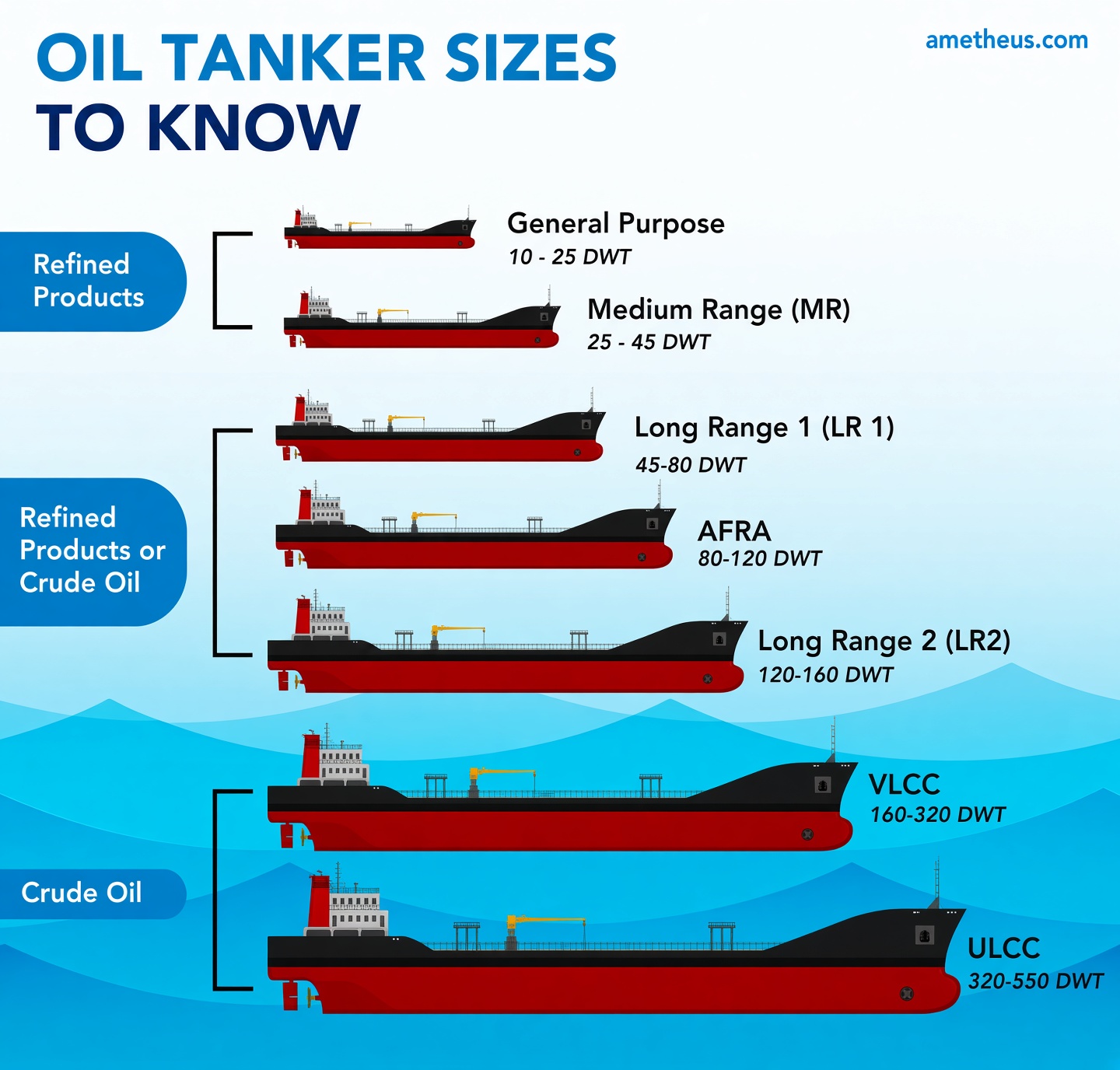
Diesel loading vessels can be tanker or bulk carriers and come in a variety of sizes. The size of a diesel loading vessel is determined by its deadweight tonnage (DWT) and length. 

Bulk carrier types

  • HandysizeA smaller vessel with a capacity of 10,000–40,000 DWT
  • MR (Medium Range)A medium-sized vessel with a capacity of 40,000–55,000 DWT
  • LR1 (Long Range 1)A medium-sized vessel with a capacity of 55,000–80,000 DWT
  • LR2 (Long Range 2)A large-sized vessel with a capacity of 120,000–160,000 DWT
  • Aframax: A tanker with a capacity of 80,000–120,000 DWT and a length of about 245.5–259.97 meters
  • Suezmax: A tanker with a capacity of 120,000–200,000 DWT and a length of about 274.30 meters
  • VLCC (Very Large Crude Carrier): A tanker with a capacity of 160,000–319,999 DWT and a length of about 333–339.50 meters
  • ULCC (Ultralarge Crude Carrier): A tanker with a capacity of 320,000–550,000 DWT and a length of about 415 meters


Loadability in Container

Drums

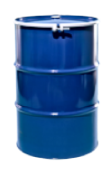
We can load 80 drums (200 liters) per 20ft shipping container

ISO Tanks

We can load approx. 20,000-26,000 liters per 20ft ISO Tank

Flexitanks

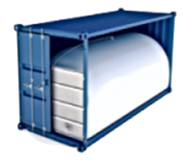
We can load approx. 18,000-24,000 liters per 20ft Flexitank

Totes

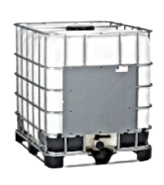
We can load 18 Totes (1,000 liters) per 20ft shipping container


The most well-known and widespread laboratory companies trusted by most market participants:

Several well-known global laboratory companies specialising in laboratory testing of petroleum products include:

  1. SGS SA
  2. Intertek Group plc
  3. Bureau Veritas SA
  4. Core Laboratories / Saybolt
  5. ALS Limited


Email: [email protected] | gks(at)ametheus(dot)com | Phone: +91-9999999538, Whatsapp: +91-9999099538
Disclaimer : We hereby declare that we do not accept or source any fuel or petroleum products from any sanctioned country.