
The Problem: Degraded Soils, Declining Yields
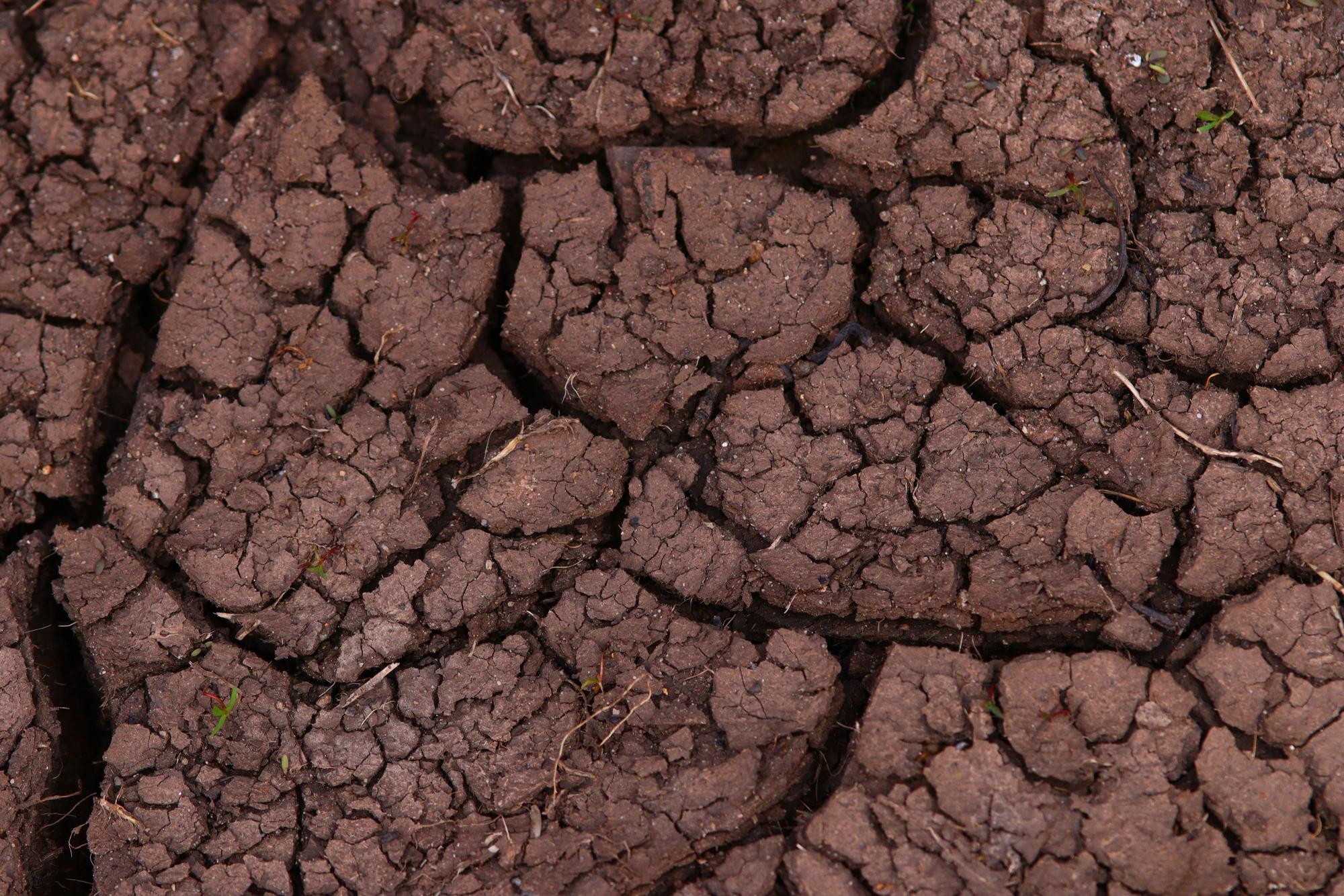
Across the tropics, decades of continuous cultivation have stripped soils of the minerals that crops need to grow. The result is a cycle that is difficult to break. Tropical soils are particularly vulnerable. High rainfall leaches nutrients from the upper layers, and naturally acidic conditions lock up what remains, making phosphorus and other essential elements unavailable to plants. Synthetic fertilisers offer a temporary fix but are expensive, often inaccessible to smallholder farmers, and can further acidify soils over time.
Approximately 500 million smallholder farmers in the Global South grow a third of the world’s food, many on soils that are severely nutrient-depleted.
Solution
How Basalt Restores Degraded Soils
Basalt is a volcanic rock rich in the minerals that depleted tropical soils lack: calcium, magnesium, potassium, phosphorus, and silicon. When finely crushed basalt is applied to farmland, it dissolves through contact with water and soil microbes, steadily releasing these nutrients into the root zone.
01 Soil pH correction : As basalt dissolves, it releases alkaline compounds that raise pH, unlocking nutrients already present in the soil and making newly released minerals available for uptake.
02 Nutrient release : Unlike synthetic fertilisers, basalt releases nutrients slowly as it dissolves. This sustained release reduces waste, lowers the risk of groundwater contamination, and provides a more consistent supply throughout the growing season.
03 Disease and pest resistance: When plants absorb silicon from the soil, it strengthens cell walls, thickens stems, and creates a physical barrier against insect pests and fungal infection — while also activating natural defence mechanisms.
04 Climate resilience: Better soil structure and aggregation means soils hold more water for longer, buffering crops against dry spells. Deeper root systems can access water and nutrients that surface soils cannot provide during drought.
ERW turns farmlands into carbon sinks. It is a carbon dioxide removal process that accelerates a natural geological mechanism. Finely crushed basalt (a calcium–magnesium-rich rock) is applied to agricultural soils. Carbon dioxide dissolved in rainwater reacts with the rock dust to form bicarbonate ions (HCO₃⁻). These ions are then transported through soils, aquifers, and rivers to the ocean, where the carbon is stored in stable forms for thousands of years (typically 10,000+ years).
In the process, farmlands become effective carbon sinks while also improving soil mineral content and crop resilience, particularly in tropical smallholder farming systems.
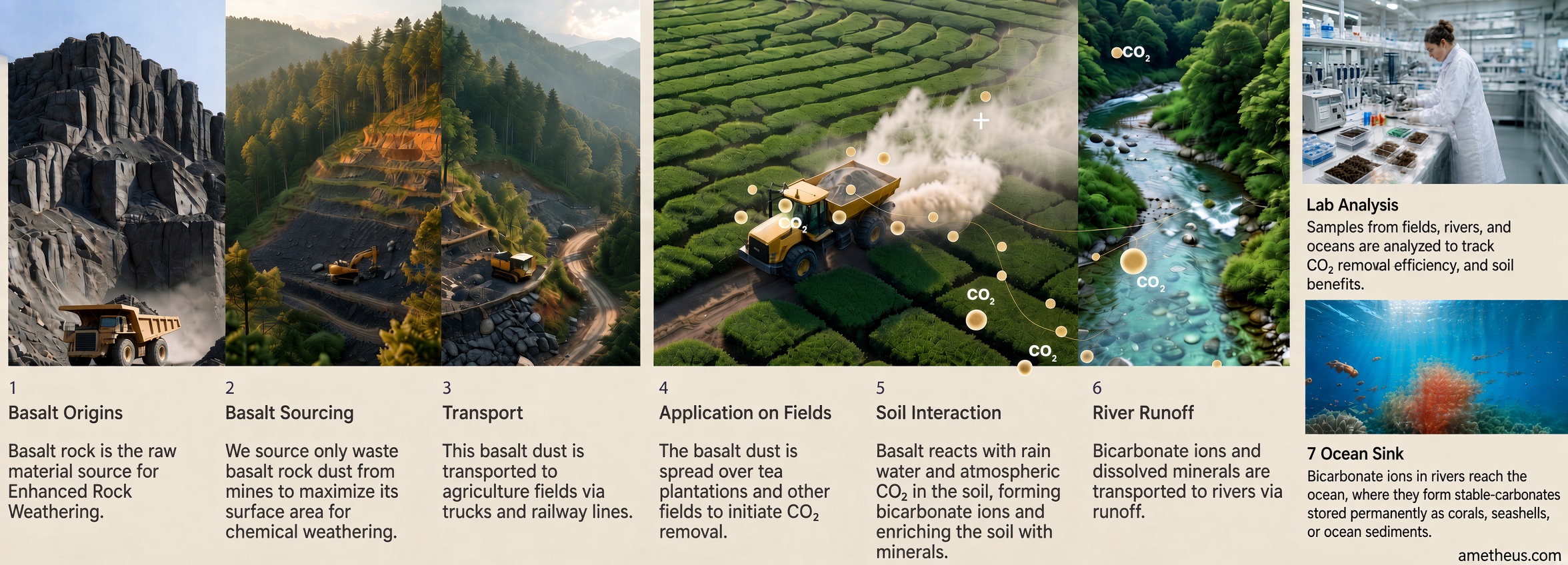
Step-by-Step Process of ERW
1. Quarrying and Preparation
- Suitable basalt is quarried from qualified sources selected for chemistry, reactivity, and agricultural safety.
- The rock is finely crushed and graded to maximize surface area (critical for speeding up the chemical reaction).
- The prepared rock dust is loaded onto trucks and transported to partner farms that meet compatibility criteria (soil type, climate, etc.).
2. Spreading on Farmland
- The basalt dust is evenly spread across agricultural fields using standard liming equipment, aligned with normal farm operations and seasons.
- When rain falls, atmospheric CO₂ dissolves in the rainwater, forming a weak carbonic acid.
- This acidic water reacts with the fine basalt particles in the soil, dissolving the rock and converting CO₂ into dissolved bicarbonate ions (HCO₃⁻).
Scientific reaction (simplified): Basalt minerals + CO₂ + H₂O → dissolved calcium/magnesium ions + bicarbonate (HCO₃⁻)
3. Transport and Long-Term Storage
- The newly formed bicarbonate ions move downward through the soil profile into groundwater aquifers and rivers.
- They are eventually carried to the ocean.
- In the ocean, the carbon remains stored in dissolved form for millennia. Over geological timescales, a portion can precipitate into solid carbonate minerals or become incorporated into marine shells and coral reefs, locking it away even more permanently.
4. Weathering Removes CO₂ As the basalt weathers, CO₂ is converted into stable carbon, mainly dissolved bicarbonate that can be stored for thousands of years.
5. Track, Measure, and Verify Projects are rigorously tracked. Field and laboratory data are collected to quantify carbon removal over time, supporting independent verification and robust carbon accounting.
Key Supporting Points
- Natural acceleration: Rock weathering has removed CO₂ from the atmosphere for billions of years. Crushing the basalt dramatically increases the reactive surface area, speeding up the process from geological timescales to human-relevant ones.
- Co-benefits: In tropical soils, the basalt releases essential nutrients (calcium, magnesium, potassium, etc.), improves soil chemistry and pH, and enhances crop resilience and productivity.
- Durability: Carbon is stored for 10,000+ years in oceans and aquifers — far longer than many other carbon removal methods.
Email: [email protected]
