
TANKER CHARTERING
Crude | LNG | LPG | Clean (CPP) & Dirty Petroleum Products (DPP)
We offer flexible and secure vessel chartering services for crude oil, LNG, LPG, and petrochemical transportation. Our fleet access, combined with market intelligence and specialist brokers, supports efficient, safe, and cost-effective maritime logistics.
Our shipping brokers and analysts provide insight into market dynamics, bunker costs, freight rates, and regulatory requirements — enabling sharper fixture decisions across major commodity segments.
Ametheus charters ships to move crude oil, refined petroleum products, and pressurised gases to refineries and customers worldwide. Logistics and distribution sit at the core of our operations — moving crude to refineries and delivering products where demand exists.
We maintain relationships with leading shipowners and brokers globally, giving us access to quality vessels for spot, voyage, time, bareboat, and COA fixtures.
Loadability in Oil Tankers
- CPP (Clean Petroleum Products): Refined products such as gasoline, jet fuel, diesel, naphtha, and kerosene. These require coated, clean tankers with segregation systems to prevent contamination.
- DPP (Dirty Petroleum Products): Unrefined or residual products such as crude oil, fuel oil, and asphalt. These are carried in robust tankers designed for heavier, more viscous cargoes.
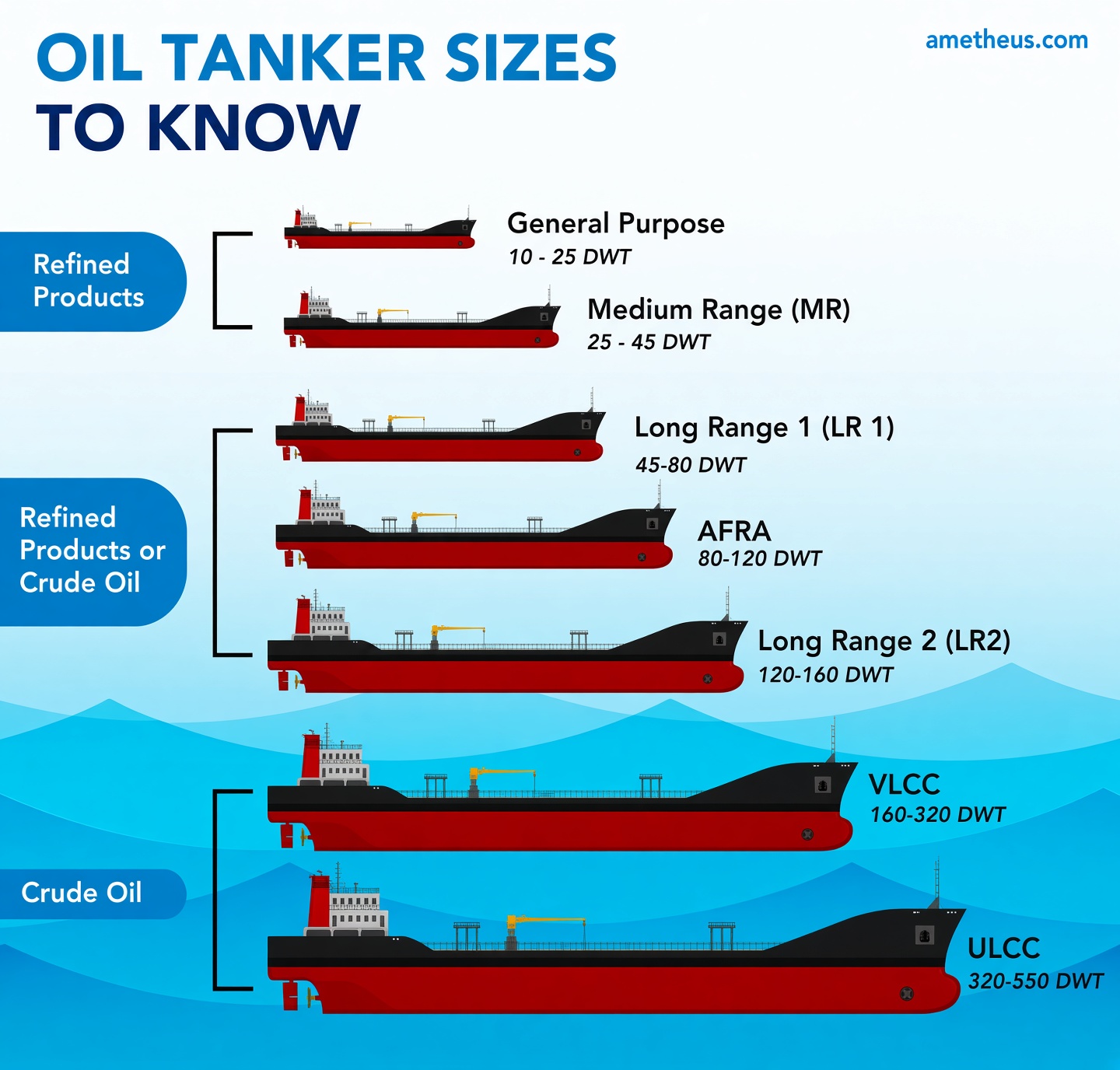
Tanker size is primarily determined by deadweight tonnage (DWT) — the vessel’s carrying capacity — along with length, beam, and draft restrictions for specific routes and ports.
Types of Tanker Vessels
Tankers are specialised ships designed for the safe transportation of liquid cargoes, primarily petroleum products, crude oil, and gases. They are classified by cargo type and size (DWT).
1. Crude (DPP) Oil Tankers
These vessels transport large volumes of unrefined crude oil over long distances. Larger classes deliver significant economies of scale on major global trade routes.
Panamax (sometimes applied to tankers): 60,000–80,000 DWT. Designed to fit the original Panama Canal dimensions; suitable for certain crude and product trades in restricted waterways.
Aframax (often overlaps with LR2): 80,000–120,000 DWT (length approx. 245–260 m). A highly versatile tanker for medium-to-long haul routes. Moderate size and draft give excellent port flexibility. Primarily used for crude oil and dirty products; coated versions (commonly called LR2) can switch between dirty and clean refined petroleum products.
Suezmax: 120,000–200,000 DWT (length approx. 274–285 m). Positioned between Aframax and VLCCs. Optimised for full-loaded passage through the Suez Canal; ideal for routes between the Middle East, Europe, and beyond.
VLCC (Very Large Crude Carrier): 200,000–320,000 DWT (length approx. 330–340 m). The workhorse for long-haul intercontinental crude transport (e.g., Middle East to Asia or Europe).
ULCC (Ultra Large Crude Carrier): 320,000–550,000+ DWT (length approx. 380–415 m). The largest crude carriers, used for massive-volume shipments on deep-water routes with suitable port infrastructure.
2. CPP (Clean Petroleum Products) Product Tankers
These vessels carry refined petroleum products and feature coated tanks with segregation systems for multiple grades.
Handysize: 10,000–40,000 DWT. Ideal for short-haul, regional, and coastal deliveries with access to smaller ports.
MR (Medium Range): 40,000–55,000 DWT (sometimes up to ~60,000 DWT). Commonly used for inter-regional and transatlantic trades.
LR1 (Long Range 1): 55,000–80,000 DWT. Suitable for larger-volume refined product shipments over extended distances.
LR2 (Long Range 2): 80,000–160,000 DWT. The largest product tankers, optimised for high-volume, long-haul refined cargoes.
3. Specialised Gas and Other Tankers
LNG Carriers: Equipped with cryogenic containment systems (cooled to −162°C). Common capacities range from 125,000–266,000+ cubic metres. Used for long-distance natural gas transport.
LPG Carriers: Designed for propane, butane, and ammonia. Types include fully pressurised (small/short-haul), semi-pressurised/refrigerated (medium), and fully refrigerated (large/long-haul, typically up to 80,000–90,000 m³ for VLGCs).
Shuttle Tankers: Specialised for offshore-to-onshore crude transport from production platforms or floating storage (typically 80,000–150,000 DWT, often with dynamic positioning).
Tank Barges: Non-self-propelled or pushed units for coastal, river, and inland transport of oil products or crude in restricted waters.
Types of Charter Agreements
Voyage Charter (VC)
The vessel is hired for a single voyage between specific ports. The shipowner covers operating costs and assumes most risks. Freight is typically paid on a Worldscale basis or lumpsum.
Time Charter (TC)
The charterer hires the vessel for a fixed period and controls commercial operations (itinerary, bunkers, ports). The owner handles technical management and crew. Hire is paid at a daily rate.
Bareboat Charter (Demise Charter)
The charterer gains full control of the vessel (acts as disponent owner) and is responsible for crewing, maintenance, insurance, and all operational costs. Commonly used for long-term arrangements.
Contract of Affreightment (COA)
A Contract of Affreightment is a multi-voyage shipping contract. The owner or carrier agrees to move an agreed volume of cargo, or to perform an agreed number of liftings, over a set period. No ship is named up front. The owner nominates a suitable vessel for each lifting. The charterer gets guaranteed liftings and a locked freight rate instead of returning to the spot market for every cargo.
A COA is not a single voyage charter and not a time charter. It sits between the two. It is the correct instrument when a trader, refiner, or terminal operator has a programme of repeated liftings but does not need to hire a named ship for a continuous period.
Negotiations & Worldscale
Tanker fixture negotiations are generally faster than dry cargo but focus on the same core elements: freight rate, cargo quantity, laydays, demurrage, and loading/discharge ports.
Most oil industry fixtures use the Worldscale system — a standardised freight scale based on a notional 75,000 DWT tanker. Rates are expressed as a percentage of the base (e.g., Worldscale 100, WS 175, or WS 75).
Payment Terms
1. Voyage Charter Payment Terms
Where the owner provides the vessel, crew, and covers voyage costs.
| Payment Term | Short Code | Description |
| Freight Prepaid | FPP | Full freight is paid before cargo loading. |
| Freight Payable on Discharge | FPD | Payment is due after cargo discharge. |
| Freight Payable at Sight | FPS | Payment is made upon presenting shipping documents. |
| Before Breaking Bulk | BBB | Full freight must be paid before unloading starts. |
| Cash Against Documents | CAD | Payment is made upon presentation of documents (B/L, Invoice). |
| Letter of Credit (Sight/Usance) | SLC / ULC-30/60/90 | Sight LC = immediate payment; Usance LC allows 30/60/90-day delay. |
| Net Payment Terms (Post-Discharge) | NET-30 / NET-60 / NET-90 | Payment is due 30/60/90 days after discharge. |
| Payment Against Sales Proceeds | PASP | Payment is made only after the buyer sells the cargo. |
Best for charterers (buyers): FPD, NET-90, ULC-90, PASP (delays payment, improves cash flow).
Risk for shipowners: Delayed payments and exposure to the charterer’s financial stability.
2. Time Charter Payment Terms
Where the charterer hires the vessel for a period, pays daily hire, and covers bunker and port costs.
| Payment Term | Short Code | Description |
| Hire Payable in Advance | HPA | Charterer must pay hire before vessel delivery or for each period upfront. |
| Hire Payable in Arrears | HPA-15 / HPA-30 | Hire is paid 15 or 30 days after the hire period. |
| Hire Payment Against Invoice | HPI | Payment is due after receiving an invoice (e.g., every 15/30 days). |
| Bank Guarantee Secured Hire | BGH | A bank guarantee ensures timely payment. |
| Letter of Credit for Hire Payments | LCH | Hire is secured via an LC (sight/usance). |
Best for charterers: HPA-30, HPI, LCH (deferred hire payments).
Risk for owners: Late payments and risk of unpaid hire.
3. Bareboat Charter Payment Terms
Where the charterer takes full control of the vessel, pays all costs, and hires it long-term.
| Payment Term | Short Code | Description |
| Lease Payment in Advance | LPA | Payment is made before vessel delivery. |
| Lease Payable in Arrears | LPA-30 / LPA-90 | Payment is made every 30/90 days after use. |
| Balloon Payment at Lease End | BPLE | Large payment due at the end of the lease term. |
Best for charterers: LPA-90, BPLE (longer payment flexibility).
Risk for owners: Exposure to non-payment if the charterer defaults.
Preferred Positions
Best payment terms for the shipowner
BBB (Before Breaking Bulk): freight must be paid before any cargo is discharged at the destination port. The owner is paid before the cargo is released to the consignee.
Best payment terms for buyers (charterers)
- Voyage Charter: NET-90, PASP, ULC-90
- Time Charter: HPA-30, LCH
- Bareboat Charter: LPA-90, BPLE
Ready to Charter
For competitive fixtures, market updates, and specialist support, contact the Chartering Desk.
Email: [email protected] · cc [email protected], [email protected]
Web: www.ametheus.com/tanker-chartering
Preferred communication timings (IST)
- Calls: 09:00–19:00. Please do not call after 19:00.
- WhatsApp: Text until 22:00; we will reply within that window where possible.
- Email: Write at any time. Replies during working hours.
