
Aalphaa Soil – Proprietary Enhanced Rock Weathering Soil Conditioner
HSN Code: 31010099
Aalphaa Soil is a proprietary end-product designed to accelerate natural carbon dioxide removal while regenerating agricultural soils. It combines finely processed basalt with a carefully formulated organic blend to deliver both long-term carbon sequestration and immediate agronomic benefits. It is particularly suited to tropical and subtropical farming systems.
Composition of Aalphaa Soil
- Calcium: 1.7% minimum
- Magnesium: 1.0% minimum
- Iron: 5.5% minimum
- Manganese: 0.08% minimum
Typical oxide composition (varies by source): SiO₂ 45–57%, Al₂O₃ 13–16%, Fe₂O₃ 6–12%, CaO 8–12%, MgO 2–8%, plus K and trace elements.
Derived from: Basalt Rock
Standard pack sizes: 10 kg, 25 kg
Note: Exact values depend on the specific quarry source. A full Certificate of Analysis including major oxides, micronutrients and heavy-metal screening should be provided with commercial lots.
Scientific Description of Aalphaa Soil
Aalphaa Soil is not a single pure chemical compound. It is a proprietary blended soil amendment consisting of:
- 70–90% fine basalt rock dust (primarily calcium-magnesium, iron and manganese silicate minerals)
- 10–30% organic blend (compost + biochar)
Primary Reactive Minerals in the Basalt Fraction
Basalt typically contains a mixture of the following silicate minerals that drive Enhanced Rock Weathering:
Key Chemical Reaction (Enhanced Rock Weathering)
Simplified overall reaction for carbon dioxide removal (diopside example):
A more general form commonly used for basalt: Silicate minerals (Ca, Mg) + 2CO₂ + H₂O → (Ca²⁺, Mg²⁺) + 2HCO₃⁻ + dissolved silica
What the reaction does
- Atmospheric CO₂ dissolves in rainwater → forms carbonic acid (H₂CO₃).
- The acid attacks the silicate minerals in the fine basalt particles.
- Calcium and magnesium ions are released into the soil solution.
- Bicarbonate ions (HCO₃⁻) are formed — this is the form in which carbon is transported to rivers and eventually the ocean for long-term storage (10,000+ years).
The organic fraction (compost + biochar) does not participate directly in the CO₂ sequestration reaction. It improves microbial activity, moisture retention, and handling properties of the product.
In short: The active chemical identity of Aalphaa Soil for carbon removal is finely ground calcium-magnesium silicate rock (basalt). The governing process is the classic silicate-weathering reaction that converts atmospheric CO₂ into stable bicarbonate.
How Aalphaa Soil Conditioner Works
-
Quarrying and Preparation Suitable basalt (a calcium–magnesium silicate rock) is quarried from qualified sources. The rock is finely crushed and graded to maximise reactive surface area. It is then blended with the organic fraction under controlled conditions to produce a consistent, farmer-friendly product. The finished material is transported to partner farms that meet compatibility criteria (soil type, climate and crop system).
-
Application on Farmland Aalphaa Soil is applied evenly across agricultural fields. When rain falls, atmospheric CO₂ dissolves in the rainwater, forming a weak carbonic acid. This acidic water reacts with the fine basalt particles, dissolving the rock and converting CO₂ into dissolved bicarbonate ions (HCO₃⁻).
Scientific reaction (simplified): Silicate minerals in basalt + CO₂ + H₂O → dissolved calcium/magnesium ions + bicarbonate (HCO₃⁻)
-
Transport and Long-Term Storage
- The newly formed bicarbonate ions move downward through the soil profile into groundwater aquifers and rivers.
- They are eventually carried to the ocean.
- In the ocean, the carbon remains stored in dissolved form for millennia. Over geological timescales, a portion can precipitate into solid carbonate minerals or become incorporated into marine shells and coral reefs, locking it away even more permanently.
The Organic Blend – Function and Results on Soil
The organic component (primarily compost + biochar) is a critical differentiator of Aalphaa Soil. It has been specifically formulated to address the practical limitations of pure rock dust while amplifying soil-health outcomes.
Key functions of the organic blend
- Improves soil biological activity by providing a carbon-rich habitat and food source for beneficial microbes and fungi.
- Enhances moisture-holding capacity and reduces surface crusting.
- Significantly reduces dustiness during handling and application, improving operator safety and farmer acceptance.
- Acts as a carrier that helps keep the fine basalt particles in closer contact with soil moisture and root zones, accelerating early weathering reactions.
Observed results on soil
- Faster establishment of microbial communities and improved nutrient cycling.
- Better soil structure and aggregate stability.
- Increased water retention and reduced irrigation demand in the short term.
- More uniform distribution of minerals in the root zone.
- Higher farmer adoption due to easier handling and visible early soil improvements (softer tilth, better moisture response, and reduced dust).
In tropical smallholder soils, the combination of basalt minerals and the organic blend restores essential nutrients, improves soil chemistry, strengthens crop resilience, and supports higher productivity while permanently removing atmospheric CO₂.
Application Method – Spraying System & Recommended Quantity
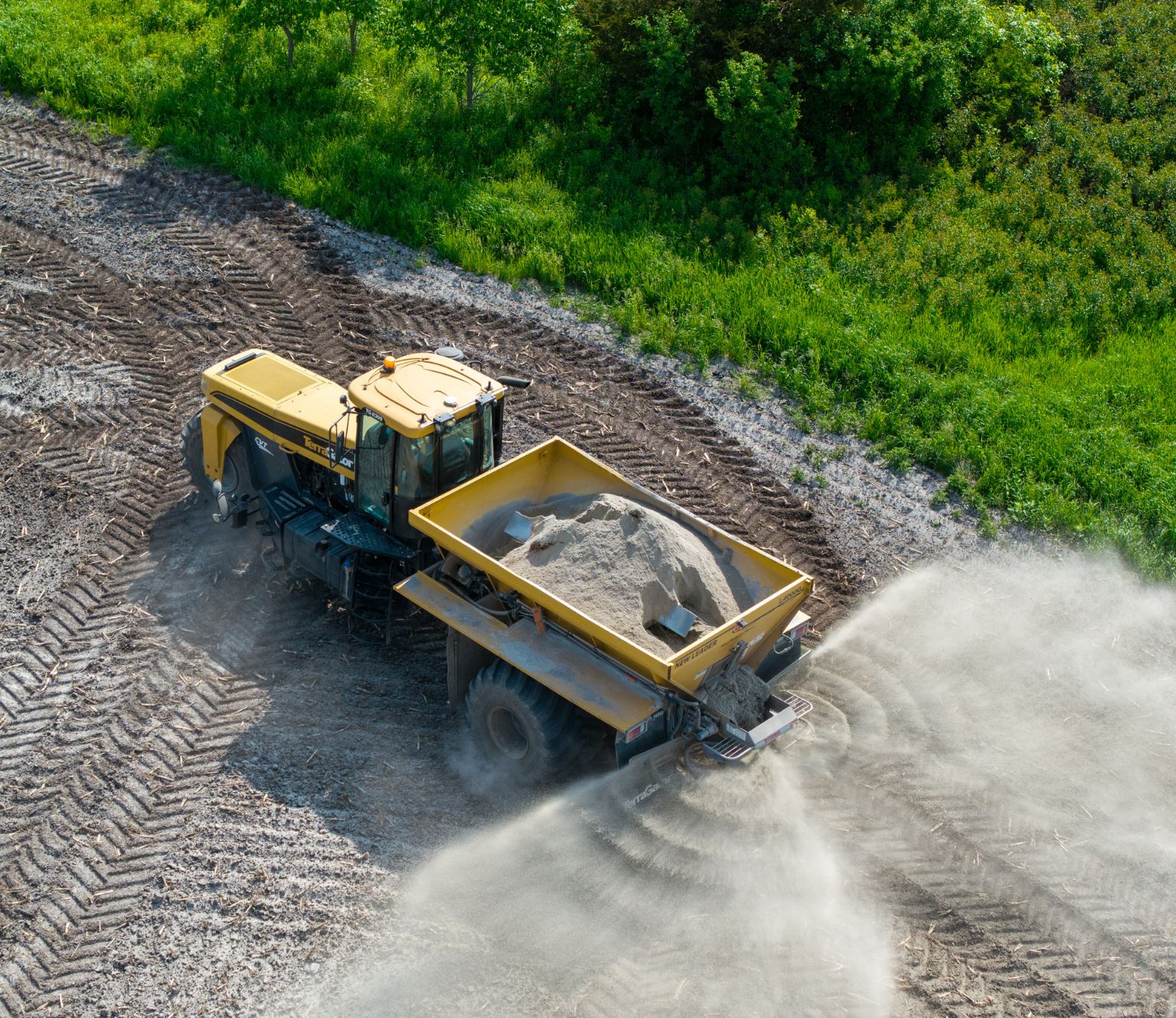
Aalphaa Soil is designed for flexible application across different farm scales — from large mechanised operations to smallholder fields. While conventional dry spreading is possible, the slurry spraying method is strongly recommended for superior uniformity, reduced dust, and better incorporation into the topsoil. Manual application by hand is also fully practical and effective.
Recommended Application Options
- Mechanised / Spraying System (Preferred for larger areas)
- Use tractor-mounted boom sprayers, high-volume slurry tankers, or fertigation-compatible equipment with continuous agitation.
- Continuously agitate the tank to keep the suspension uniform (basalt particles settle if left static).
- Apply under calm conditions and preferably before expected rainfall or light irrigation so that the material is washed into the soil surface.
- Manual / Hand Application (Ideal for smallholder farms)
- Farmers can easily carry bags of Aalphaa Soil into the field and spread it by hand.
- The product can also be mixed with water in simple containers or backpack sprayers and sprayed manually.
- Hand spreading or manual spraying allows precise placement around plants or in smaller plots and requires no specialised machinery.
Mixing Ratio for Spray Application Prepare a workable slurry by mixing 1 part Aalphaa Soil with 3–4 parts water (by weight). Example: 250–300 kg of product per 1,000 litres of water. Adjust water volume according to equipment capacity (or backpack sprayer size) and desired coverage.
Recommended Application Rates
- Soil building / general agronomic use: 2.0 – 3.5 tonnes of Aalphaa Soil per hectare
- Higher carbon-removal focus: 4.0 – 5.0 tonnes per hectare (single or split applications)
These rates can be applied in one pass or split into two applications (pre-planting and mid-season) depending on crop calendar and available equipment or labour. Always incorporate lightly into the top 10–15 cm of soil where possible, or allow rainfall/irrigation to move the material into the root zone.
Summary of Benefits
- Accelerates natural enhanced rock weathering for durable CO₂ removal
- Supplies calcium, magnesium and other minerals essential for plant health
- Improves soil biology, structure and moisture dynamics through the organic blend
- Reduces dust and improves ease of application
- Suitable for tropical and subtropical smallholder and commercial farming systems
- Delivers both climate impact and measurable agronomic returns
Aalphaa Soil represents a practical, science-backed pathway to turn everyday farmlands into productive carbon sinks while regenerating the living soil that farmers depend on.
For technical guidance, bulk supply or field trial support, please contact the Aalphaa / Ametheus team.
Email: [email protected]
