

What Is Large or Black Cardamom?
Large cardamom, sometimes called black cardamom or Himalayan cardamom, is a spice native to the Eastern Himalayas. It belongs to the same botanical family as green cardamom but is a completely different species.
Unlike its smaller green cousin, large cardamom pods are reddish-brown, coarse-skinned, and dried over a wood or smoke fire, which gives it a bold, smoky character.
A few quick facts worth knowing:
- Botanical name: Amomum subulatum
- Also called: Black cardamom, badi elaichi, alaichi (Nepali)
- Flavor profile: Smoky, earthy, slightly camphor-like, with none of the sweetness of green cardamom
- Common uses: Garam masala blends, slow-cooked meats, biryanis, and traditional Himalayan and Ayurvedic remedies
As a high-altitude cardamom crop, it thrives only in a narrow set of mountain conditions. That narrow window is exactly why three countries dominate global supply.
Where black cardamom actually grows
Black cardamom is not a lowland crop. Large cardamom (Amomum subulatum) grows in a narrow band of the eastern Himalayas, roughly 800–2,000 metres above sea level, on cool, shaded, high-rainfall slopes. That belt runs across eastern Nepal, the Indian states of Sikkim and West Bengal (the Darjeeling and Kalimpong hills), and parts of Bhutan. It is a small, specific geography, which is exactly why so few countries grow it at all.
The whole belt shares a very particular environment, and it is the reason all three origins can grow the crop at all:
- Altitude:Roughly 600–2,000 metres above sea level
- Rainfall:Heavy monsoon rainfall, typically 2,000–3,000 mm a year
- Temperature: Cool, humid climate that avoids frost and extreme heat
- Soil: Well-drained, slightly acidic forest soil rich in organic matter
- Shade: Native trees like alder and utis regulate temperature and enrich the soil naturally
Understsnding Black Cardamom Quality
Amomum subulatum · Alainchi · Badi Elaichi · Large Cardamom
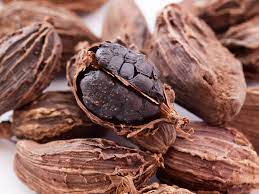
Whole dried pods of Himalayan black cardamom — the form buyers should always specify first.
This page is written for importers, spice packers, restaurant suppliers, and masala manufacturers who need to judge quality before they place an order. It explains what good Nepali black cardamom looks like, how it is graded, which lab numbers actually matter at the border, and how to buy from Ametheus with a clear specification.
1. What you are buying
Black cardamom is the dried fruit of Amomum subulatum, a ginger-family crop native to the eastern Himalaya. Nepal is the world’s largest producer of this spice. It is not a dark version of green cardamom (Elettaria cardamomum). The two plants, flavours, and uses are different.
Nepali pods are spindle-shaped, ridged, and light brown to deep brown-black after curing. Inside are dark, oily seeds. The aroma is camphor-like and resinous. When the crop is cured over a traditional wood-fired bhatti, it also takes on a roasted, smoky note that cooks use in biryani, pulao, garam masala, nihari, stews, and braises.
Common trade names: black cardamom, large cardamom, greater cardamom, badi elaichi, kali elaichi, alaichi / alainchi.
HS code: 0908.31.00 (neither crushed nor ground).
Typical growing belt: eastern hill districts of Nepal — Taplejung, Panchthar, Ilam, Sankhuwasabha and neighbouring mid-hills — generally 600 to 2,000 metres above sea level, often under alder (utis) shade.
2. Why quality is decided at drying, not at the warehouse
Two numbers decide whether a consignment clears a serious buyer’s QA desk and a regulated border: moisture and aflatoxin. They are the same problem stated twice. Aflatoxin is produced by moulds that grow on a crop that was not dried and stored properly. Control moisture at curing, and aflatoxin stays down.
That is why Ametheus treats drying method, moisture cap, and a per-lot lab report as part of the product — not as optional paperwork.
3. Commercial grades — order by size, not by a vague ‘best quality’
Serious buyers order a grade. Size is the first commercial sort. You will also hear older South Asian trade names used for roughly the same bands.
| Export grade | Pod size | Also called | Best for |
| Bold | 22–28 mm | Jumbo Jet / large dana | Gulf retail, restaurants, gift packs — the pod is seen whole on the plate |
| Medium | 18–22 mm | Bold / Standard / Super Deluxe | Default wholesale grade for spice blenders, jar packers, biryani kitchens |
| Fine | Under 18 mm | Ordinary / Chhote / Chalan Chalti | Masala mills and grinders — milling removes the size premium |
Rule of thumb: if the customer will see the whole pod, buy Bold or Medium. If the pod will be ground, buy Fine and keep the savings. Paying Bold prices to mill the spice is wasted money.
Local Nepal market grades (Jumbo Jet, Super Deluxe, Chalan Chalti) sort mainly on size, tail cutting, colour and hygiene. Export buyers should still convert those names into millimetres plus a lab sheet.
4. The specification sheet that should travel with every lot
Use the table below as the buying specification. Ask Ametheus to confirm the lot against it before you pay.
| Parameter | Buyer specification (recommended) |
| Botanical identity | Amomum subulatum Roxb. — not Chinese cao-guo (Amomum tsao-ko) |
| Origin | Nepal, named eastern hill district — not a blended re-export |
| Form | Whole dried capsules; tails clipped on Bold and Medium |
| Appearance | Intact, ridged pods; deep brown to brown-black; no white mould spots |
| Aroma | Camphor / cineole, resinous; smoke only if Bhatti-cured was nominated |
| Moisture — flue / machine dried | ≤ 9% |
| Moisture — traditional Bhatti | ≤ 12% |
| Aflatoxin B1 | Below 5 ppb (EU and GCC mandatory limit) |
| Total aflatoxin (B1+B2+G1+G2) | Below 10 ppb (common ESA / buyer cap) |
| Pesticide residues | Below EU and UAE MRL limits |
| PAH | Non-detect preferred on closed-flue lots; tested and reported on Bhatti lots |
| Extraneous matter | Max 1% (stalks, dust, stones); tails controlled by grade |
| Empty / malformed capsules | Max 3% |
| Insect damage | Max 3%; no live infestation |
| Volatile oil (indicative) | Typically about 1–2.5% in the seeds; higher is better after a clean dry |
These figures follow common export practice for Nepali large cardamom, including the moisture and aflatoxin limits used by EU and GCC buyers and the European Spice Association style minima for the crop. Always take the lot’s own laboratory certificate as the contract number.
5. Two cures — choose the flavour, then lock the lab numbers
The same hill crop can be finished in two ways. They are two specifications, not a ‘premium’ line and a ‘cheap’ line. Nominate the cure when you request a quote.
| Closed-flue / machine dried | Traditional Bhatti (wood-fired) | |
| How it is dried | Indirect hot air; smoke does not touch the pod | Slow cure over a managed wood fire on raised racks |
| Typical moisture cap | ≤ 9% | ≤ 12% |
| PAH profile | Generally non-detect when the flue is closed | Present; must be tested and disclosed per lot |
| Flavour | Cleaner, resinous, cineole / camphor forward | Smoky, roasted, campfire-forward — the classic Himalayan note |
| Colour | More even maroon to deep brown | Darker, sometimes sooty black |
| Best buyer fit | EU / GCC QA desks, retail jars, powder, private label | Biryani houses, masala kitchens, Pakistan and Gulf savoury trade |
EU Regulation 2023/915 sets PAH limits for certain dried spices. Cardamom is not among the entries those limits currently cover, so a documented Bhatti lot is not automatically barred from the EU or UK on PAH grounds. Many private QA specs still want the number on paper. Ametheus will state the drying line on the quote and attach the matching test.
6. How to inspect a sample in five minutes
Ask for 200–500 g of the exact grade and cure you intend to buy. Do this before you commit to a container or air shipment.
- Look: pods should be whole, not crushed. Colour should be even for the nominated cure. Reject white spots (mould) and heavy dust.
- Feel: firm, not brittle and hollow. Lightweight rattling pods are old or insect-damaged.
- Smell: crush one pod. You want sharp camphor, resin and — if Bhatti — clean wood smoke. Musty, cardboard or sour notes mean moisture trouble.
- Split: seeds should be dark brown and slightly oily, held in fibrous pulp — not pale, dusty or loose.
- Paper rub: a heavy soot smear is typical of an open village fire, not a managed kiln. Note it; it is a flavour and PAH clue, not automatically a defect.
- Match the bag to the sheet: pod length in millimetres, moisture %, aflatoxin, harvest season, and district of origin.
7. What a serious shipment should carry
Documents are part of quality. A lot without papers is a lot you cannot defend to customs or to your own customer.
- Commercial invoice and packing list
- Certificate of origin issued in Nepal (FNCCI or equivalent) — naming Nepal, not a third-country re-export
- Phytosanitary certificate from Nepal’s Department of Agriculture
- Per-lot laboratory report (DFTQC, SGS Nepal, or equivalent ISO lab) covering aflatoxin, moisture, pesticide residues and PAH
- Fumigation certificate where the destination requires it
- Halal documentation on request
Ametheus can send the current lot’s lab report with the quotation, before you pay, and can courier a sample for your own laboratory.
8. Packing, shelf life and typical order sizes
| Format | Typical use |
| 200–500 g sample | Grade and aroma approval before a first order |
| Retail jar / pouch (250 g–1 kg) | Kitchen and specialty retail |
| 5–10 kg cartons | Restaurants, small packers |
| 25 kg jute or PP sack with food-grade liner | Standard export sack |
| Palletised sacks (e.g. 500 kg) | Importers and industrial users |
| Ground powder, moisture-proof pack | Masala and seasoning plants — mill only from a fresh, tested lot |
Store whole pods cool, dry and dark, in the original liner, away from strong odours. Whole capsules keep their oil far longer than powder. Do not grind until you need to. Properly cured pods at the moisture caps above are stable in normal export transit.
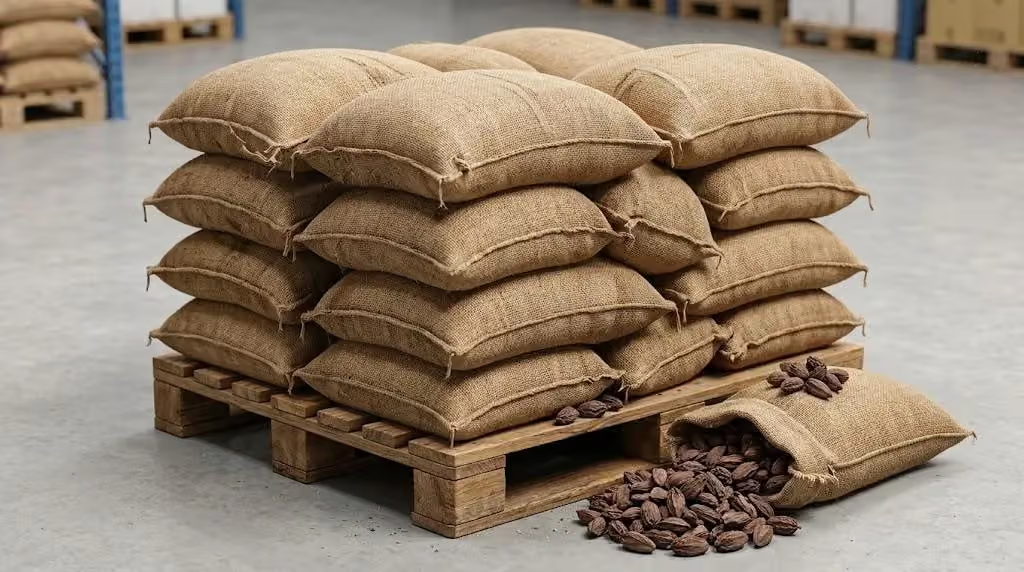
Ametheus ships wholesale black cardamom as a 500 kg export pallet: 20 × 25 kg jute sacks, shrink-wrapped and strapped to a standard pallet for forklift handling. Each sack is a separate 25 kg unit — the wrap is for transit, not long storage — so on arrival cut the film and let the jute breathe. Order one grade (Bold, Medium or Fine) or a mixed-grade pallet; nominate flue-dried or Bhatti-cured. Every pallet moves with a Nepal certificate of origin, phytosanitary certificate and per-lot lab report (HS 0908.31). Best for distributors and manufacturers with a known monthly draw. Larger bookings can go as a full 20-foot container (about 18 tonnes). Ask Ametheus for a pallet quote by grade, cure and destination.
9. Culinary note for your customers
Black cardamom is a savoury spice. One or two pods scent a pot of rice, a meat braise, or a litre of stock. The smoky Bhatti style is the flavour people expect in biryani and slow North Indian and Himalayan cooking. The cleaner flue-dried style is easier in retail blends and in kitchens that do not want visible soot or a heavy smoke note.
It is not a substitute for green cardamom in sweets, chai, or Scandinavian baking. Sell it as itself.
10. How to buy from Ametheus
Ametheus sources Himalayan black cardamom in Nepal for buyers who want a named origin, a written grade, and lab numbers they can show a customer. We do not sell an unnamed ‘mixed hill lot’ as a premium grade.
- Tell us the grade (Bold / Medium / Fine), the cure (flue-dried or Bhatti), the pack size, the destination port, and the volume.
- We send a specification, the current lot lab summary, and a quote (sample 200–500 g on request).
- You approve the sample against the sheet. Nothing is packed for export until the lot matches what you signed.
- We pack, attach origin and phytosanitary papers, and ship under the Incoterm you nominate (FOB, CIF or as agreed).
| Product: Himalayan black cardamom (Amomum subulatum), whole pods or fresh-ground powder.
Ask for: grade, drying line, moisture, aflatoxin B1, harvest season, and district of origin on the quote. Email: [email protected] |
11. Honest limits
Good export cardamom is grown with little or no synthetic pesticide in many eastern Nepal orchards, and residue reports often confirm that. A clean residue report is not the same thing as organic certification. If your market requires an organic mark, say so at quote stage so the lot can be matched — or declined — honestly.
Chinese Amomum tsao-ko is a different species. It is larger and usually less smoked. Do not accept it against a Nepal alaichi specification.
Price alone is a poor grade. Very cheap offers often mean high moisture, mixed districts, re-sorted Indian market leftovers, or a crop that will not pass aflatoxin at destination.
Quick reference for your purchasing file
| Ask this | Acceptable answer |
| Species? | Amomum subulatum |
| Where grown? | Named Nepal district |
| Grade? | Bold 22–28 mm / Medium 18–22 mm / Fine <18 mm |
| How dried? | Closed flue or Bhatti — nominated, not mixed silently |
| Moisture? | ≤ 9% flue or ≤ 12% Bhatti, on a lab sheet |
| Aflatoxin B1? | Below 5 ppb, tested on this lot |
| Papers? | India or Nepal COO + phytosanitary + lab report |
Himalayan spices, specified and documented.
Quality framework aligned with common India / Nepal export practice and international buyer limits (EU / GCC aflatoxin, ESA-style spice minima). Confirm every lot against its own certificate.
