
Jute Sliver / Kenaf / Mesta SliverSemi-processed fibre for spinning mills, nonwovens and export buyers |
At a glance
- Semi-processed jute fibre in sliver form for yarn and nonwoven production.
- Available in Tossa and Meshta types, sorted by quality and fibre length.
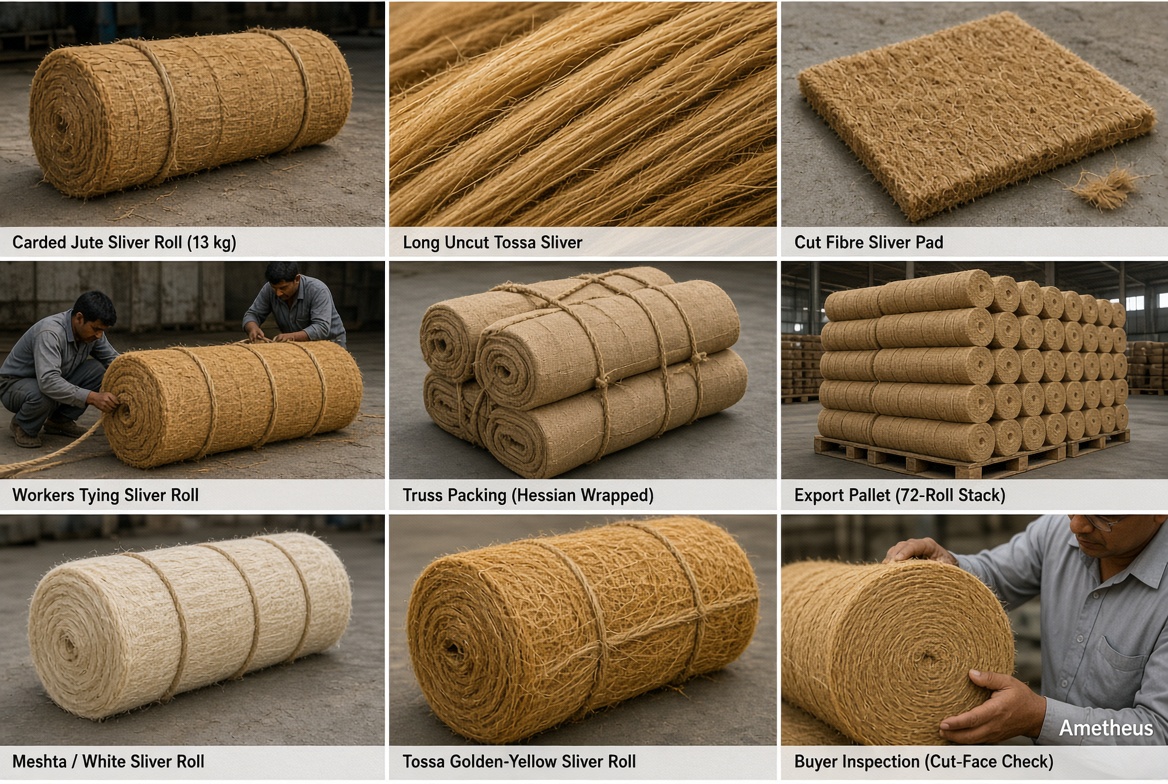
- Packed in 13 kg rolls, tied with rope, and palletized for bulk delivery.
- Supplied only in wholesale and export bulk quantities.
Product description
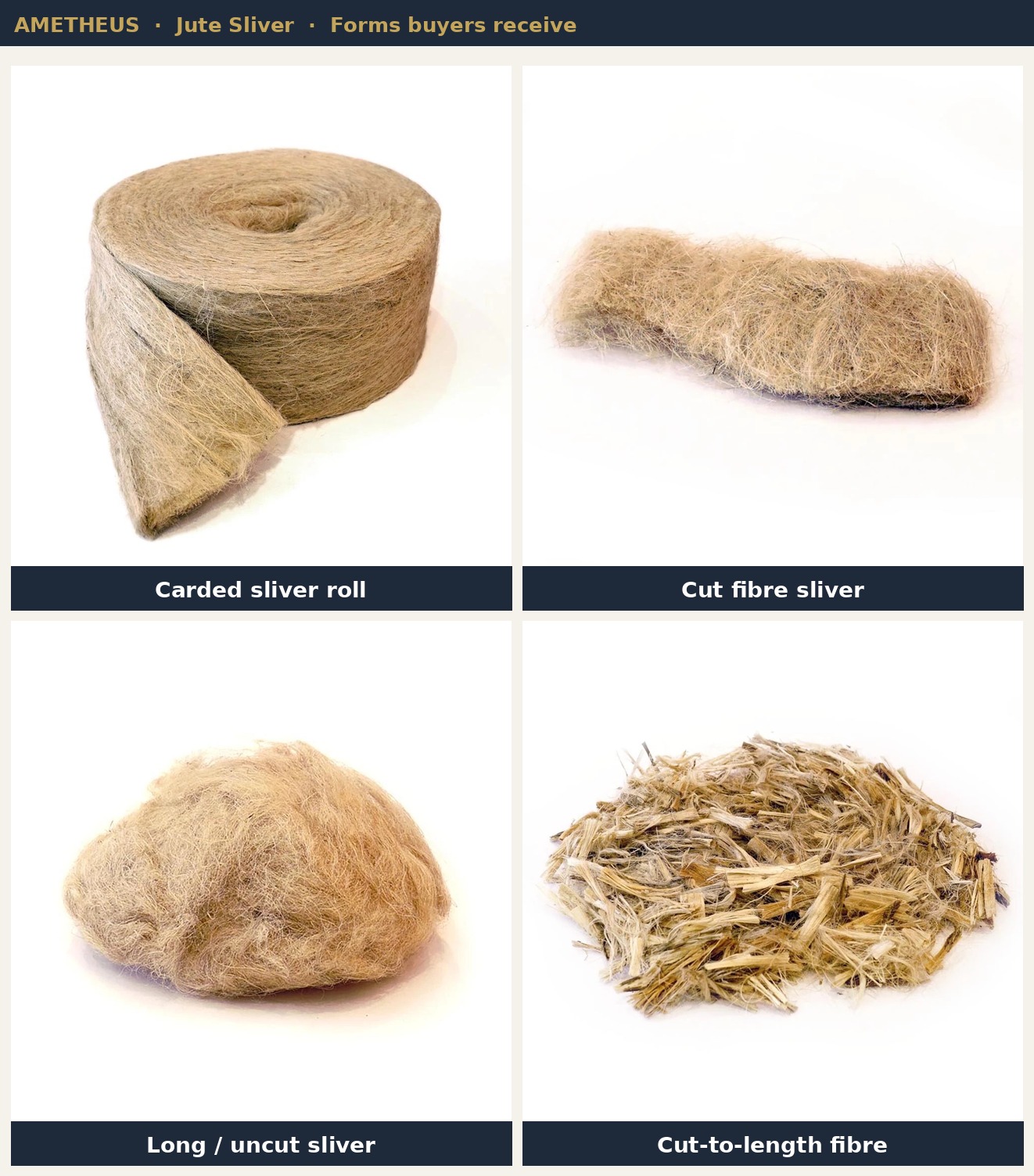
Jute sliver is the step between raw jute and spun yarn. Fibre is opened and carded into a continuous, loosely aligned strand, then wound into a roll. Mills feed that roll into drawing and spinning. Buyers use sliver when they want more even fibre, controlled moisture and a packing format that travels cleanly in a container.
Ametheus offers long fibre and cut fibre. Long fibre is the usual choice for spinning. Cut fibre is used for coarser counts, twine, rope and some nonwoven lines. Grades are named so your mill and our mill use the same language: Meshta White A, B and C, and Tossa BTE, BTC, BTD (golden yellow) and BTCB.
Each roll is tied with jute rope to limit breakage. Rolls are wrapped in hessian or loaded on export pallets. Cut fibre is packed in rope-bound bales.
Specification
| Item | Detail |
| Material | Natural jute — Tossa and Meshta / Mesta / Kenaf as ordered |
| Fibre type | Long fibre and cut fibre |
| Meshta grades | White A, White B, White C |
| Tossa grades | BTE, BTC, BTD (golden yellow), BTCB |
| Moisture | Up to 16% maximum |
| Roll weight | 13 kg per roll |
| Roll packing | Each roll tied with 4 jute ropes. 3 rolls wrapped in hessian cloth. |
| Pallet packing | 72 rolls per pallet |
| Cut fibre packing | Bales wrapped with jute rope |
| HS code | 5303.90 — jute and other bast fibres, processed but not spun |
| Origin / ports | Bangladesh. Load port Chittagong or Mongla as per Proforma Invoice |
| Supply basis | Wholesale / export bulk only. Typical minimum: one 20 ft FCL |
How to choose a grade
| Grade | Family | Look | Typical use |
| White A | Meshta | Clean white / cream | Finer yarn and brighter blends |
| White B | Meshta | Light cream | Standard white yarn and twine |
| White C | Meshta | Commercial white | Coarser counts and mixing |
| BTE | Tossa | Golden, good luster | Stronger yarn, better finish |
| BTC | Tossa | Golden / reddish | Main spinning and twine line |
| BTD | Tossa | Golden yellow | Sacking-side yarn and general use |
| BTCB | Tossa cutting | Darker / coarser | Rope, coarse yarn, filler |
Where buyers use sliver
Spinning and yarn
Spinning mills take sliver as the feed for various yarn counts. Long fibre sliver gives better tensile behaviour and fewer breaks on finer counts.
Kenaf and Mesta blends
Nonwoven and paper lines use Meshta / Kenaf sliver as a lighter, cost-effective blend for agricultural mats, soil-erosion control and reinforced sheets.
Twine, rope and textiles
Cut fibre and coarser Tossa grades suit twine, rope and heavier weaving where a more rigid fibre is preferred.
Geotextile and erosion control
Tossa or Meshta sliver is blended into jute geotextiles for slope work, drainage and road projects. The fibre keeps structure and stays water-permeable.
Paper and pulp
Long fibre sliver is fed into pulping for natural and recycled paper. Fibre length supports sheet tensile strength.
Bio-composites and boards
Automotive and construction plants mix sliver into moulded boards for door panels, partitions and acoustic parts. The sliver form blends more easily with polymer matrices.
Furniture and handicrafts
Smaller volumes go into stuffing, padding and binding for furniture, eco-cushions and mats.
Bulk export
Sliver is a standard export input for processing units in markets such as China, Turkey, Egypt and Thailand. Fixed roll weight and moisture make long-haul handling simpler.
How to buy from Ametheus
Send one email with grade, long or cut fibre, quantity in metric tons, destination port, Incoterm (FOB Chittagong / Mongla, or CFR / CIF), payment (LC at sight, TT or CAD) and whether you want SGS inspection. We reply with a Proforma Invoice. Price is quoted on that PI. Grade, moisture, packing and price bind only when the PI / contract is accepted.
Typical lead time is 20–35 days after LC or TT and specification lock. Mixed grades in one container are possible if agreed before stuffing.
Request a quote
| EMAIL THE RFQ at [email protected] |
This page is a commercial introduction. It is not a price list and not an offer capable of acceptance. Final terms appear only on a signed Proforma Invoice or contract.
